

Lacuna
Preliminary notes on abjection

I unpublished this post for a while and I’m putting it back up now. I’m not sure if that will resend it to everyone so if you get a second email about this, just ignore it, sorry! I’m also now posting reading round-ups and you can check out the first one here.
Z says that he was also involved with someone who’d lived in Berlin for several years. She had moved home to go back to school, for architecture, and they had become lovers last summer. I ask him what happened with her, and he hesitates and says, I still love her and respect her, she’s a good friend, but then in September…
Last spring I thought that I was pregnant, and when my period finally came, it tore through me and left an open wound. I felt grief for something that may or may not have been there, for the failure to be able to create it. In my teens and early twenties, pregnancy was my deepest, most obsessive fear, and I would engage in compulsive reassurance-seeking from friends who could do little more than tell me to wait a few more days. Then I got sick and lost my period for a year and a half, and I now have no way of knowing if I could conceive at all. Like always, I’m probably making a big deal out of nothing. But every month there is still a feeling of failure, of ab-jection – a violent separation, a pre-mourning1.
Many of my dreams centre around pregnancy. Often, in the dreams, I am heavily pregnant, and no one around me seems to notice or care. It’s a mundane occurrence to everyone around me, my dearest friends, my parents, because it is a very basic thing that anyone could do at any time, but in the dream, I cannot imagine how no one understands that it is completely upending. When my mother was pregnant with me, she dreamed of the physical loss that I would sustain in childhood. In another dream, she tells me what not to say to the baby: we terrify each other.
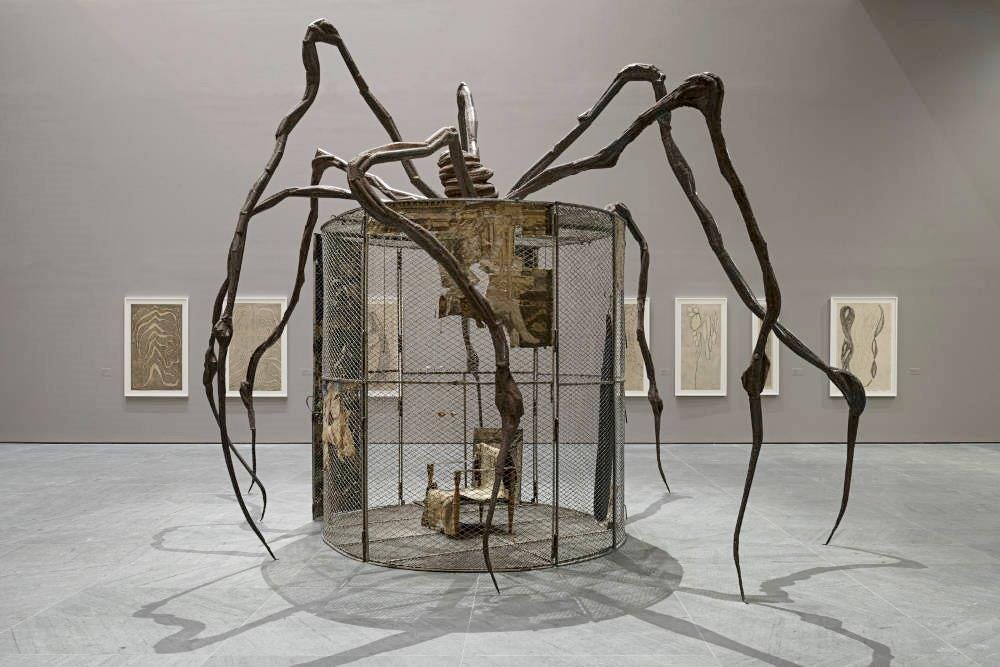
Kate Zambreno, in her essay on the photographer Catherine Opie and the artist Louise Bourgeois, writes of the duplicity of bodies, of whether we ever get our body back in the after, but also of duplicity as a doubling: the space that mothering creates, the dyad-as-Cell2. Julia Kristeva asks: How do we approach this unsentimentally3? In rough order, there is a space, a fullness, a loss, a hollowing-out, and then a new space is created, as the dyad moves to the external (“Always inside and outside, self and other, neither self nor other, an intervening space”1). It is this intervening space within the dyad that I am interested in, and the space around the dyad, too.
And yet dyad is a duplicitous term. After all, there is no such thing as a baby4.
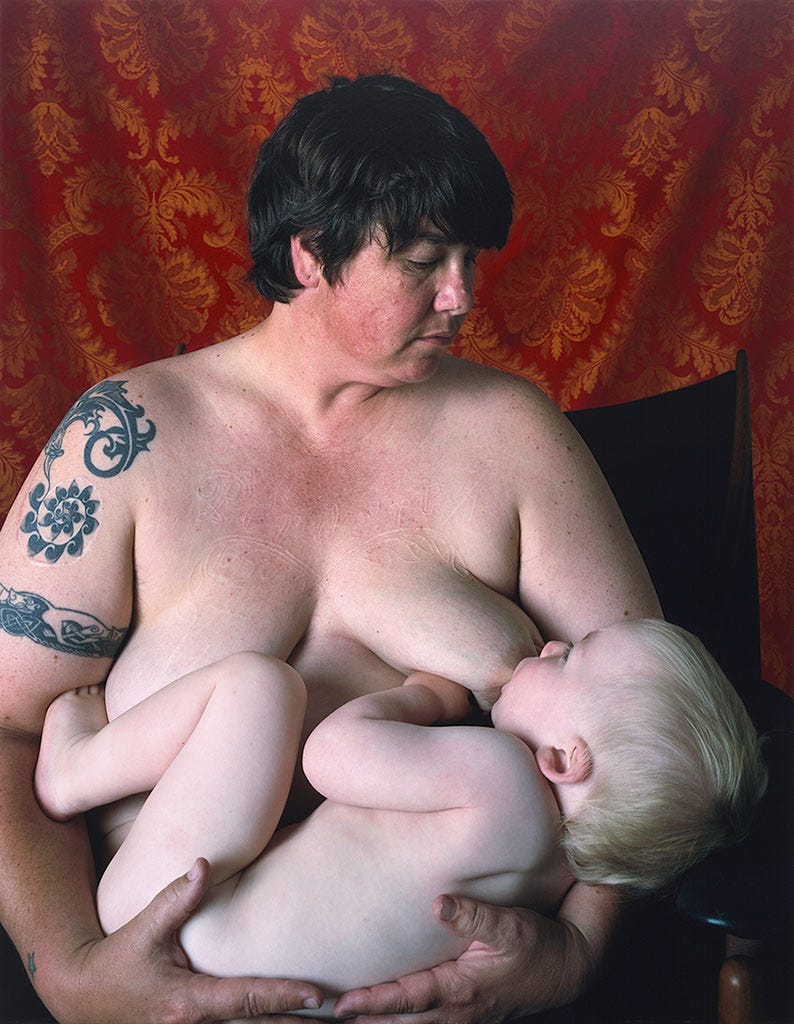
I think about babies a lot, and my own selfish desires, and my selfish desire for a partner who would act as a container for the intervening space between/within myself and my child. For Kristeva, the lover-father splits the pregnant woman in two (before there is subject or object, there is ab-jection) but remains fully outside of her, becoming what I see as a holding space for the nascent dyad. I am attracted to this matryoshka of spaces: the mother-infant dyadic space, the mother’s stepping back “[t]o leave room; in other words, to disappear” to allow for the infant to become a person in her absence3, and a lover-father-partner who would create a kind of extracellular space around the Cell. In other words, I want to hold and be held. This is mundane.
Z says, of course, we [ ] seven days after we found out. But it was so hard on her, and we didn’t stay together. It’s been around a year and a half since I’ve last seen Z: then, we met across the street from his restaurant, and I gave him back the books I’d borrowed indefinitely from his ex-girlfriend’s collection. He must be in his late thirties now. He doesn’t look older. He is handsome, tall, nondescript. Many times, in the intervening space, I have thought I’ve seen him on the subway. We hold hands across the table and smile at each other. There has never been much between us, and very little now. I want to tell him my unsolicited thoughts. I think that he, like many of the men I am fond of, could be a good-enough father. I think that he should go back to the woman he loves and be a good-enough person for her. Instead I tell Z, I’m sorry I disappeared two years ago, but I think you know that it’s because I fell in love.
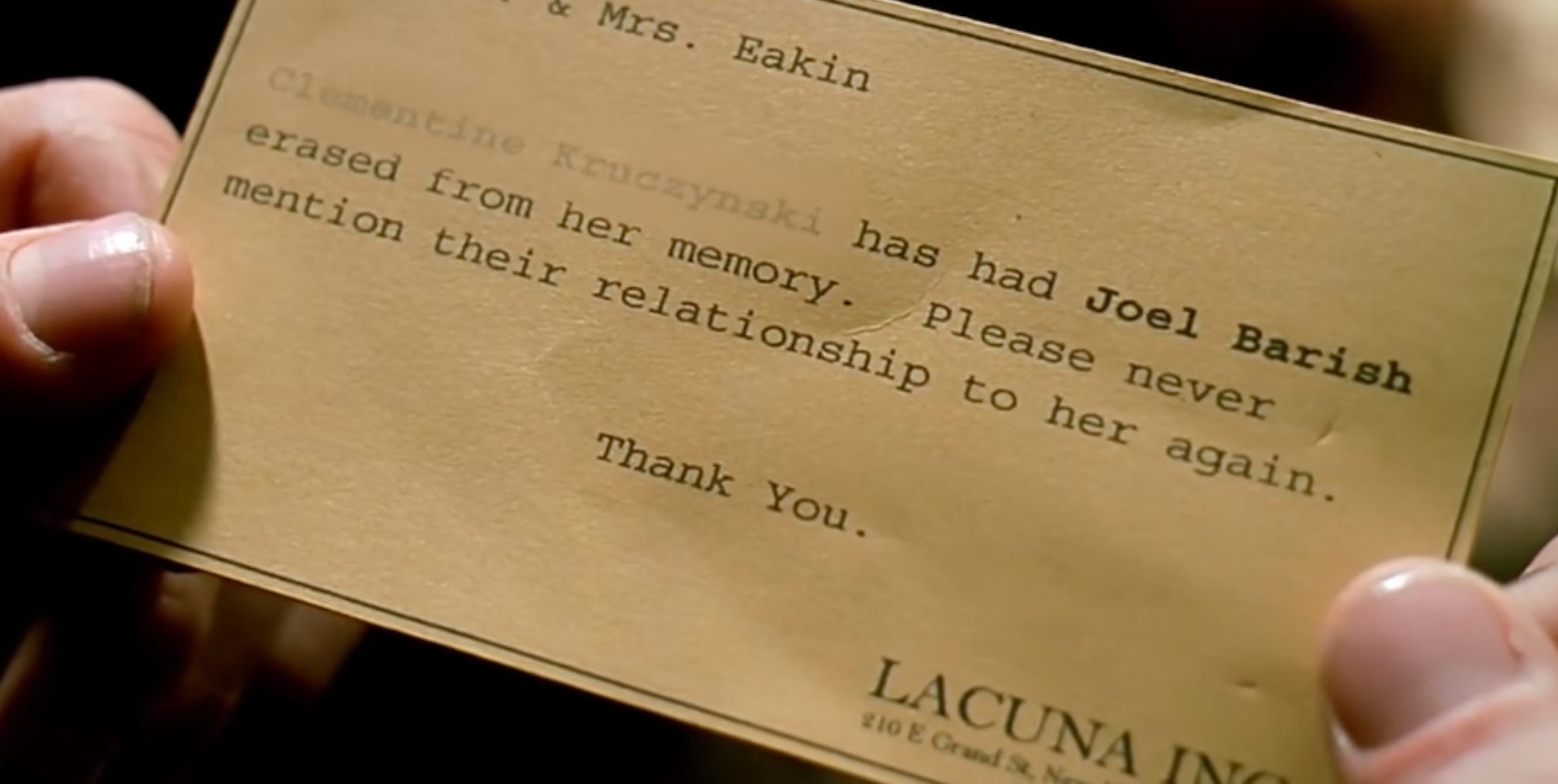
I watched Eternal Sunshine for the Spotless Mind again. I knew it was a terrible idea to go to the late showing at the Carlton, the night before Valentine’s Day, which is a silly made-up holiday that I’m actually really invested in, which is a thing I’ve started to admit to myself. I held it together until the scene when Clementine is crying over having felt ugly as a child, and Joel kisses her face under the covers and says, you’re pretty, you’re pretty, and as they are suffused in the warm light, he begs to keep this memory, just this one. The end of a long relationship is an unravelling of these kinds of memories, the sweet ones, the ones which are now thrown into sharp relief. I feel like Joel on the beach, dragged backwards through the whole thing, grabbing on where I can. The moment I knew I loved him, maybe, in the sunshine on the patio at our place that doesn’t exist anymore. The first time he told me he loved me, two autumns ago, on the tiny bed in his new apartment. But even then, with all the things that came to light, with what I know now, the lights start to flicker off, and I just can’t get traction on anything else now.

One of Joel and Clementine’s fights centre around Clementine’s desire to have a baby. As they walk through an arts market, she tells him she wants a baby in a way I always used to read as flippant. Joel, I thought, was not entirely wrong to treat Clementine with disdain, as though she were faintly ridiculous. In the space between my last rewatch of Eternal Sunshine and this time, I have said out loud to the man I loved, many times, I want a baby. I had not, until then, stood on the precipice between what Kristeva calls the “I” and the multiverse (i.e., the realization that you want a baby, that you could be more-than-one)1. And then I met him, and I stepped over the precipice, into the intervening space.
For Kristeva, the desire to mother, to have a baby, is a passion which defies rational understanding, a “modality of sense prior to signification”1. To be in the state of such passion is literally to be in a state of emergency. In Eternal Sunshine, Clementine is in this vulnerable, terrifying state, and Joel responds with annihilating cruelty, by scoffing at her capacity to mother. In my own life, I have seen myself reduced to a potentially great mother, one who should be fully self-sufficient even while being split-apart, without the need for a holding space or container. This, too, is a kind of annihilation.


Zambreno writes of the cell created and burst apart in Louise Bourgeois’ Spider as “the web that the spider [Bourgeois’ mother] encloses and protects”. The first space created for us was created by our mothers – the space in which “creativity is made possible for the child”3. I see this space as generative, as a space for work, the dyad as productive space. To mother is, presumably, to create a space within which work can be done: the “post-partum space” where Zambreno herself laboured to bring these essays into the world as she nursed her daughter2. I think of the dyad-cell as a functioning and dynamic thing like any cell, not as an indivisible thing but as a space which nurtures, excretes, produces, sustains. After Kristeva, I think of this generative space as contained within the steady, sustaining love of the partner.
I have tried, for a long time, to make the loss I sustained in childhood into a productive space. I tried to make my relationship with J into what Kristeva calls a ‘container’, the “’gap’ between me and the world, subject and object, an intervening space”1. He said that I had dissolved into him, and he had never asked for this. In leaving him I ab-jected him “in order to separate […] and re-become an ‘I’”. It is in leaving that we simulate the real abjection, the final splitting-apart of the mother-infant dyad, which entails separation but never the destruction of the intervening space, which “refus[es] to collapse”. Here, I would suggest that the extracellular space, the space created by one’s partner, must be resilient enough to survive the real ab-jection, too.
Kristeva writes of a reliable love, of the necessity of tenderness, safety, dependence in one’s lover. In the intervening space, I still believe in a love which won’t drag me backwards but instead would bear me forward, which would be strong enough to hold me, wouldn’t mistake my being-held for annihilation.
1 – Julia Kristeva, “Reliance, or Maternal Eroticism”, 2008.
2 – Kate Zambreno, Appendix Project, 2019.
3 – Kristeva, “Motherhood Today”, 2011.
4 – D.W. Winnicott, The Maturational Processes and the Facilitating Environment, 1965.
This essay features microscopy images by my dear friend, biologist, artist and science writer Jess Nash. You can find more of their work at jessnash.com.
💕!